The Starting Point
Boris Allemann’s acquisition marked the beginning of a new chapter for Allemann Goldschmied. The existing website dated back to an earlier phase of the company and no longer reflected either its current work or its product catalog. The brand had little online presence, and there was no sales channel. Boris Allemann therefore decided to completely overhaul the digital presence as an investment in visibility, brand, and growth.
The Foundation for Visibility
Before design and technology came into play, we focused on the basics: Who is Allemann Goldschmied targeting online? What are these people looking for? And how do they navigate the website? Only with clear answers to these questions can we build a website that makes an impact.
Raptus worked with Boris Allemann to refine the relevant target audiences, ranging from existing regular customers to the Bernese public and online shoppers. At the same time, a search strategy was developed with SEO partner Digital Leverage to ensure that Allemann Goldschmied is visible where people are searching. Based on this, the information architecture was developed: a structure that clearly separates the brand, studio services, and product range while simultaneously connecting them.
Our contribution
- Target audience analysis and refinement of customer profiles
- SEO Strategy in Collaboration with Digital Leverage
- Information architecture for websites and online stores
- A clear distinction and connection between the brand, studio, and retail worlds

Character becomes apparent
With the strategic framework in place, the next step was to give the brand an identity that reflected Boris Allemann and his studio and appealed to the defined target audiences.
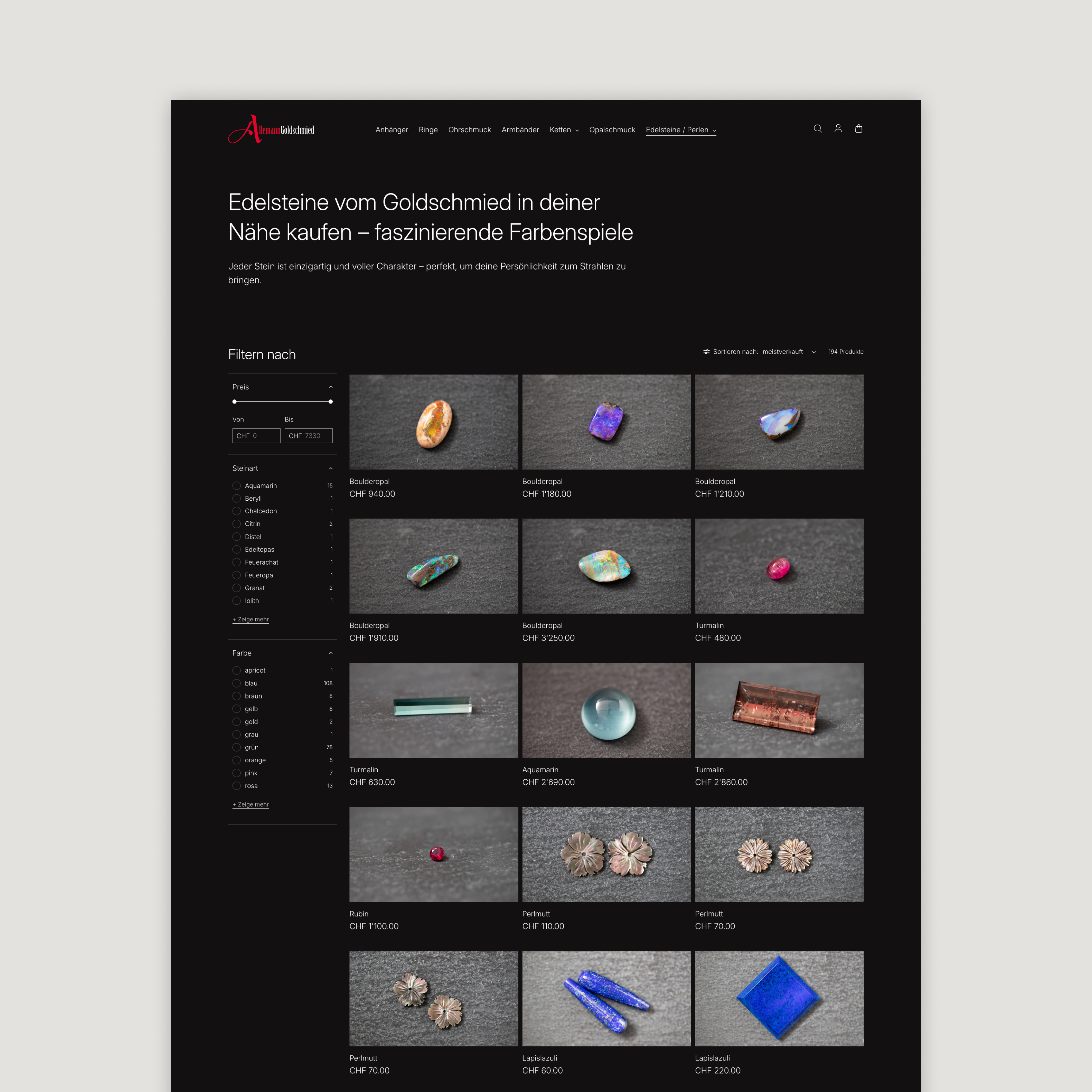
Through a series of iterations, Raptus developed the brand’s visual identity: the typography, color palette, and overall design framework were carefully coordinated to equally reflect the brand’s craftsmanship, tradition, and contemporary identity. The corresponding visual style and imagery were created in collaboration with Digitale Massarbeit. In the UI design, these elements were consistently applied to the website and online store, featuring understated presentations of the jewelry and clear navigation through the content.
Our contribution
- Style Development and Creation of the Visual Brand Identity
- Typography, color scheme, and basic design framework
- UI Design for Websites and Online Stores
- Integrating Digitale Massarbeit's visual style into the overall look


From Concept to Live Performance
With a solid strategy and design in place, we moved on to the technical implementation across two platforms, each of which does what it does best: Webflow for the brand website, and Shopify for the online store.
Raptus built the Webflow website so that Boris Allemann could maintain and further develop it on his own. At the same time, the Shopify store was created as a standalone sales channel, seamlessly integrated with the brand’s identity. A significant part of the work focused on product data: the entire catalog was structured, categorized, and organized in a way that makes it easy to find and purchase online.
Why Webflow and Shopify?
Webflow is ideal for brand websites that require a high level of design sophistication and are intended to be maintained by the client themselves, without the need for a developer behind the scenes.
Shopify is a proven platform for online stores that handles all the back-end operations: order processing, payment integration, shipping, and inventory management. Keeping these two areas separate allows both branding and sales to focus on their respective strengths and makes each area scalable independently of the other.
Our contribution
- Building the brand website in Webflow
- Setting up the online store on Shopify
- Organization and formatting of the entire product catalog
- Integrating the website and online store into a cohesive overall brand presence